
Understanding Modern Communication Through The Lens of Comedy

Lately, we have been fortunate enough to have what I believe are the generation’s best two comics, Nathan Fielder (Rehearsal, Season 2) and Tim Robinson (Friendship, full-length movie), released original content in May. To say we’re spoiled is an understatement. Additionally, both of these recent works have really helped us appreciate why they are great pieces of art.

Both comedians really toy with the idea of cringeworthy and/or awkward communication. In a society where in-person verbal and nonverbal communication continues to decline, both comedians effectively lean into this concept.

Fielder has focused more on addressing awkward communication moments and utilizing his “Fielder Method” to help learn about his subjects’ verbal and non-verbal tendencies. At the same time, Robinson expresses all the inner thoughts that we all have had from time to time, albeit in a humerously great exaggeration.

I am currently enrolled in a Global Leadership course where we are discussing different cultural communication frameworks. The communication framework that America and many Western nations currently exhibit is a “Linear-Active” culture — one in which we are focused on a specific timeframe and agenda in our communication with one another. Both comedians push that boundary, and inadvertently (or maybe intentionally in Fielder’s case) challenge the status quo in communication styles. Arguably, both push “Reactive” culture tendencies, where opinions are formed based on listening to others before forming strong opinions.

This is why it makes sense that I have been enjoying West Coast Swing. The whole dance is based on hearing the counts of the music, “listening” to your partner, and then reacting within the dance. It is a very potent form of non-verbal communication.

My good friend, Pastor Zac Yonko (MDiv, Ashland), noted the theological connections.

From a pastoral perspective, I think there’s a beautiful theological layer here. The gospel is ultimately a story of divine communication — God choosing to enter our awkward, broken, miscommunicating world through the Word made flesh. Jesus didn’t avoid cringe; He entered it. He touched lepers, asked hard questions, told disruptive parables, and wept in front of people. That’s the kind of non-linear, reactive, embodied presence of both comedians.

Satire, when done well, doesn’t just critique; it invites repentance and curiosity. And maybe, in a world of endless noise and scripted agendas, what we need most is the humility to listen — to the Spirit, to one another, even to absurdity — and to laugh our way back to being human again.

Although both Fielder and Robinson are using humor to exploit modern communication tendencies. Satire may very well be the most effective form of learning how to communicate in the 21st century.

Episode 15: Jason Romano of Sports Spectrum

Jason Romano is the executive producer of the Sports Spectrum Podcast, which has been around for the last seven years and highlights Christians in the sports industry through podcast episodes, magazines, and website content. He shares about his love of Christ, how he interacts with athletes in the sports industry, and gives a few tips about how to be successful in sports media.  

Is Politics Influencing our Faith? Or is our Faith Influencing our Politics?

To my fellow believers in Christ,

I have been debating on posting this for a week, and after processing and thinking through it, I think this message could be a good reminder for all of us, regardless of how we felt about the election or what “side” we stood on.

For full transparency, I chose to write in a candidate, so I’m trying to approach this as unbiasedly as possible. This is not a stance that I plan to take every election from here on out, but I think this election especially is a good reminder that political parties are man-made institutions.

As believers, we could be reminded at times that we should check our processing of politics to ensure that it comes from a Christ-centered perspective instead of letting our human politics influence our faith walk.

If the foundation of our faith truly guided us to vote for a particular presidential candidate–whether a Democrat, Republican, or third party/write-in–fantastic! I believe that fulfills our civic duty and honors our authority as Christ calls us to do.

However, let us self-examine ourselves to see if we are processing our viewpoints from a Christ-centered perspective or letting our political viewpoints shape how we process our relationship with God.

And it’s not easy; I am trying to discern this as well, and I have honestly fallen short several times listening to content leaning towards both leading political platforms in this country and then making a spiritual judgment from someone’s interpretation as opposed to getting my worldview from the bible, so please don’t see this as an exhortation.

This is not to say that I don’t have convictions that align with specific platforms; I most certainly do. But it has become easy to align ourselves completely with one platform or another before really thinking deeply about how Jesus would approach a particular situation.

I have tried to do this recently: If I am looking for spiritual content to process and ponder, I try to ensure that it is from a) the Bible, most notably, or b) a church or a well-reputable Christian source that cites the Bible (your home church, etc.).

If I am looking for political content, I will try to listen to political podcasts and compare that to my understanding of what I believe the Lord wants from our world.

In other words, I try not to understand (insert political social media pundit here) as a theologian, and I try not to understand (insert pastoral/theologian figure here) as a political pundit.

And no party or political system is perfect and will never be this side of eternity.

Let’s continue to exercise our freedom and privilege of voting (we are a rare generation of people who have had the freedom to choose our leaders during our lifetimes, so thank God for that) and even go as far as being passionate about our politics. However, we must ensure that we utilize our faith as our compass for how we vote and engage in politics, as opposed to processing voting from a “worldly” viewpoint.

Let’s not forget that we should continue to be kind to one another. Show compassion and grace to those who do not see eye to eye with you politically.

God Bless.

Communication & Educational Leadership Series Episode 5: Dr. Sara Shaban

Dr. Sara Shaban is an assistant professor of journalism at Seattle Pacific University, a CCCU (coalition of Christian colleges and universities) school just miles northwest of downtown Seattle.  Prior to receiving her PhD, Shaban was a freelance journalist in the Middle East. We talked about the importance of power in the midst of a communication structure, the importance of clarity in communication, the leadership lessons that can be found in literature, and more.

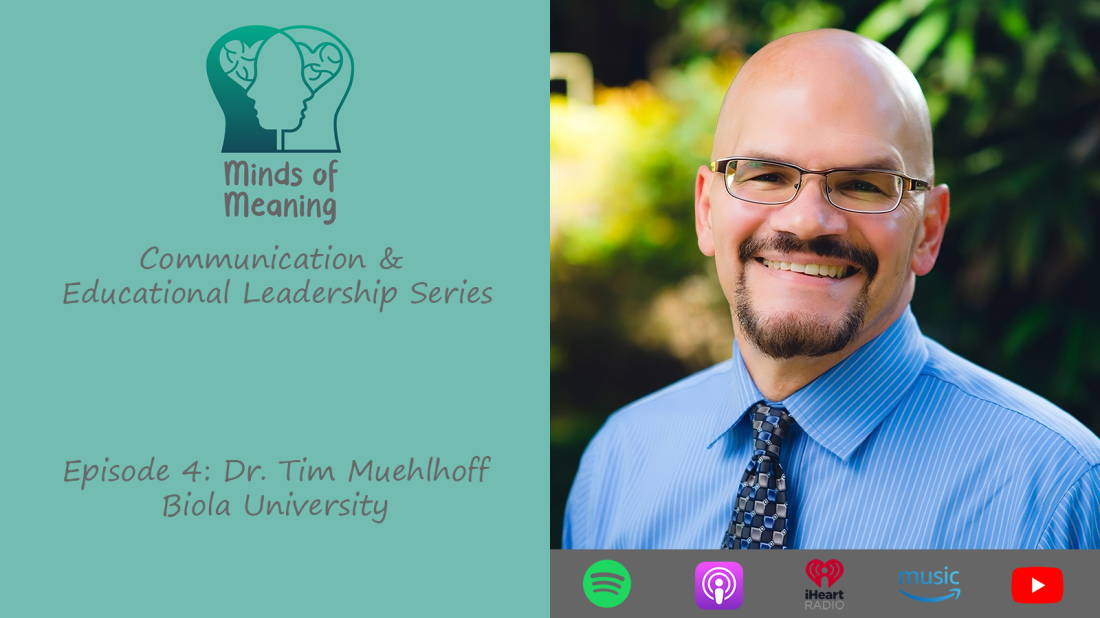
Communication & Educational Leadership Series Episode 4: Dr. Tim Muehlhoff

Dr. Tim Muehlhoff is a professor in the Department of Communication Studies at Biola University in La Mirada, California, where he has served for the past 20 years. We discussed the nature of the decline of liberal arts education, the importance of facial expression amidst leadership discussions, the current state of cancel culture, and many more topics as well.

Can We Solve Our Media Literacy Crisis?

Note: This article is written in response to the general public’s social media response to the assassination attempt of President Trump in Butler, PA, on Saturday, 7/13.

As a professor in digital communications, I look for the good in media to help influence the next generation.

As a general rule, most media outlets tonight did a terrific job across all political slants as each station provided solid commentary on how terrible the events were this evening and how we as a country need to band together and as Van Jones elegantly said tonight on CNN, “we need to look at our political opponents as opponents and not enemies.”

Rex Huppke absolutely nails this article on the head for USA Today, criticizing the general public’s outcries on social media channels, calling out conspiracy theories and other lies that were spread on social media as soon as the attempted assassination occurred.

The biggest issue we face in the current communication climate is not biased media, regardless of political views, rather the ability to spread misinformation freely at such a fast rate of time, and the ongoing increase of AI certainly accelerates the ability to provide information that may be untrue.

Media literacy is becoming more challenging daily. I don’t know what the answer is, but I can provide two suggestions:

1. Limit social media consumption. My only personal accounts are Facebook, LinkedIn, and Snapchat. I am no longer on Instagram, no X, or TikTok. The latter two can especially be catalysts for misinformation.

2. Provide education and guidance to the younger generations, who have grown up with media their whole lives. The way that media has been incorporated into their lives at such a young age means there is no understanding of life for that generation without it. I believe our goal as a society is to teach the younger generation that it is okay not to be fully consumed in media and provide further learning opportunities outside of digital technology when applicable. I am working on this, too, and I think we can be examples to the younger generation of how to effectively limit digital communication content intake.

I am blessed to teach the next generation of students how to be effective communicators, but it is going to take much more than just all of us communication instructors to help create positive change in media literacy.

Living “Transformationally” (Updated)

In the last month and a half, I have faced numerous health difficulties, including, but not limited to, countless significant pulled muscles in both legs, a stubborn middle ear infection, a sinus infection, tinnitus, muscle tingling, and steroid-induced complications—including an increased heart rate, and increased anxiety. All these things have staggered on top of one another over the last six weeks while I continued to attempt to solve “why could this be? And how do I solve problem X.” Although some of these problems have gone away, others still have persisted, leading to what sometimes feels like a never-ending cycle of health problems.

I am by nature a scheduler, a planner, one who likes to balance what I am trying to accomplish with the reality of the day. In my mind, most days are considered a success if I can complete ideally all, if not most, of what is listed on my tasks for the day.

In this sense, these health issues have pushed me to my limit. In my desire to control, I try to find every possible solution to such concerns, often leading me to worry about the worst-case scenario of each situation.

Many people view the significant list of agenda items I try to accomplish and say I am succeeding significantly. However, as much as I generally succeed, there are usually 40-50% (at minimum) of additional items on my unattainable list that I cannot complete.

I have learned the differences between transactional and transformational leadership during my doctorate studies. According to The Florida Institute of Technology, transactional leadership is defined as a leadership style “based on processes and control and requires a strict management structure.” Transformational leadership is the antithetical leadership style driven by “inspiring others to follow, and it requires a high degree of coordination, communication, and cooperation.”

One could use these principles outside of leadership circles to define how we think and how we process our lives as human beings.

In other words, as a general rule, living transactionally is simply looking for as much control as possible by living in a specific set of circumstances. However, living transformationally, although requiring more effort, allows other people to come aside you in general relationships, as well as in mentee and mentor roles, to help continue building successful living patterns.

From a spiritual perspective, I have often been reminded that submitting my needs, desires, and cares to the Lord is necessary for personal peace. Additionally, the need to obey the Word never dwindles whether we are in times of transactional or transformational tendencies.

My campus pastor, Brad Wetherell, gave an excellent sermon on Sunday about the necessity of the authenticity of our faith. In the sermon, there was a key line Pastor Brad said: “Our faith is not supposed to be obedience to earn our access into the kingdom but would rather demonstrate the authenticity of our devotion.”

Pastor Brad concluded the sermon by citing Matthew 5:3: “Blessed are the poor in spirit, for theirs is the kingdom of heaven” (ESV).

These points lead me to believe God calls us to be transformational in our relationships and leadership opportunities. We should humble ourselves to the Father and release our uncontrollable concerns to Him. As my mentor says, “Control is an illusion.”

And to clarify, this is not easy to do. I would still consider myself someone who is transactional with transformational tendencies. My goal in the coming years, with God’s help, is to continue to incrementally change and become more transformational.

I do want to mention that there are numerous situations where living transactionally needs to occur. We need to eat, sleep, work, run errands, clean the house, etc. However, we should seek out transformational mindsets amid transactional experiences. You may want to eat lunch with someone at work who could use a friend, or you could use the grocery checkout line to strike up a quick conversation. We only have a limited time on earth until God calls us home.

Speaking of which, one of my subconscious worries during this problematic health season was trying to decipher whether God has a long-term plan for me in this life. Upon reflection, I humbly believe that God has some big plans for my life yet (as I believe the same for you, too!). We should not be entitled to that notion, as we could be with him as soon as we read this article; however, trusting in God authentically will allow us to be transformational in the time he has for us on earth.

UPDATE (6/24): I came across a podcast episode from one of my favorite podcast entities, “The Holy Post,” where Christian journalist/podcaster/pastor Skye Jethani was talking with Wheaton bible scholar John Walton.

Jethani noted that we are not made to simply “serve” God (or, that Good NEEDS something from us, and our purpose is to simply do that task), but rather, more importantly, what Genesis 1 reveals is the enormous dignity of every person as an image bearer of God as a representative of His in this creation.

THAT is our purpose! We are created to be a witness to others as image bearers rather than living in consternation about how we can be God’s “tool.”

Walton added that this idea is not simply transactional, but rather a theme to use in our spiritual walks.

Society has taught us how to be effective “tools” of something, and that mentality has even spilled into our own theology, which Jethani mentions actually lessens our value and worth. What if we were to live as if we knew we were Godly creations and manifested that into our relationships, as opposed to living as a “tool,” counting down the days till eternity? The image-bearing transformational mindset makes us appreciate more of the present as we wait for the future.