
Authenticity: The Antithesis of People-Pleasing 

(Image generated by WordPress AI)

The beginning of a new semester has come upon us. There are new routines, new opportunities, and new perspectives. As I have entered a semester with certainly different routines and opportunities, I feel that God has given me some new perspectives on how to live effectively going forward.  

I have spent a lot of time in my life trying to please others, whether that is gaining lifelong friends, winning over professors and coworkers, or, of course, wooing potential significant others. Living that life can have its rewards, especially when specific personal actions lead to specific outcomes (including losing 60 pounds over a summer to successfully gain a significant other for my senior year in college); however, I have come to learn that the vast majority of these perceived controllable situations are actually quite the opposite.  

After processing and consulting with trusted individuals, I realized I had been struggling with people-pleasing. In essence, I was playing mind games with myself to appease others based on what I thought they desired from me, which, in turn, would have somehow given me more value.  

If I even move the scope back further, I realize that I often rated my life by trying to reach specific milestones within a certain time period, in order to meet some unrealistic “American Dream” standard, so that I would be further successful in society.  

On the outside, I seem to have a lot in order. I am a de facto department chair of a communications department at a four-year institution; I am pursuing a doctoral degree; I am a worship leader; I have plenty of loving family and friends; I have many enjoyable hobbies; and, most importantly, I have an all-knowing God overseeing my life. Yet, deep down, the insecurities of my life have continued to creep up on me. Those include significant student loan debt, not owning my own place yet being single, and holding theological/philosophical perspectives different from those of many others I interact with daily, among others. 

So, if my approach to “catch up” and living “normally” like others is not going to be successful, what mindset would help me live for Christ more boldly and confidently?  

I began reading Everything Connects by Faisal Hoque and Drake Baer. There are many elements in this book that, despite being secular, draw on principles first articulated in Christian thought. Most notably, living authentically.  

It says in 2 Timothy 2:15 (ESV) “Do your best to present yourself to God as one approved, a worker who has no need to be ashamed, rightly handling the word of truth.”

If I were to define authenticity before reading Hoque and Baer, I would say that authenticity is everything in a society that encourages vulnerability. What the authors add to such a definition is a guidance element to authenticity: how we discern the knowledge of certain life situations, also known as wisdom.  

Instead of focusing on comparing myself to others, I have come to realize that I need to live authentically—or relish my unique traits, ideas, and perspectives, because God made all of us uniquely and individually. I do not need to love any sinless activity any less just to cater to how others perceive the world. I can still love sports to the level of my youth; I can enjoy ’60s-’80s pop, soft rock, and R&B; I can continue to enjoy line dancing; I can still enjoy thinking deeply, regardless of what my peers and other people in my sphere say, think, or do. As Hoque and Baer mention, we should focus on being connective in our conversations rather than protective of our perceptions. If we are not in a place where we can truly be ourselves, I believe we need to re-examine the situations we get involved in.    

God has challenged me over the years to be my authentic self, which includes sharing my story with others and, hopefully, doing more public speaking and book writing in the future.  I do not need to live life in a cookie-cutter way, but in a way that is honoring and pleasing to him and lets the world know of his glory.  

Even if I have trained my brain to engrain previous, untrue tendencies, God has given us the ability to change our thinking to the point that we can change our brain waves if we take steps to change our thinking (also called neuroplasticity). It says in Romans 12:2 (ESV) “Do not be conformed to this world, but be transformed by the renewal of your mind, that by testing you may discern what is the will of God, what is good and acceptable and perfect.”  

There is time for us to renew our minds. There is time to change our perspective from worrying about living as the world wants us to, to living as God has wired us, so we can live unashamedly for the kingdom. And who knows, maybe all of the things that we worry that we need to control, God will show his provision when we are least expecting it, as we know he always provides us with what we need, as it states in Philippians (4:19).  

Thus, a good charge for us can come in the words of Pastor Dan Cox from Wonder Lake Bible Church, who, recently, in his 25th anniversary sermon ended the sermon with the following “Because God has shown himself faithful in every way- by His nature, by His promises, and to His people- we can trust Him enough to live faithfully, love deeply, and serve wholeheartedly.”  

Note: Several excerpts from this post were taken from discussion board replies from Regent University coursework.  

Understanding Modern Communication Through The Lens of Comedy

Lately, we have been fortunate enough to have what I believe are the generation’s best two comics, Nathan Fielder (Rehearsal, Season 2) and Tim Robinson (Friendship, full-length movie), released original content in May. To say we’re spoiled is an understatement. Additionally, both of these recent works have really helped us appreciate why they are great pieces of art.

Both comedians really toy with the idea of cringeworthy and/or awkward communication. In a society where in-person verbal and nonverbal communication continues to decline, both comedians effectively lean into this concept.

Fielder has focused more on addressing awkward communication moments and utilizing his “Fielder Method” to help learn about his subjects’ verbal and non-verbal tendencies. At the same time, Robinson expresses all the inner thoughts that we all have had from time to time, albeit in a humerously great exaggeration.

I am currently enrolled in a Global Leadership course where we are discussing different cultural communication frameworks. The communication framework that America and many Western nations currently exhibit is a “Linear-Active” culture — one in which we are focused on a specific timeframe and agenda in our communication with one another. Both comedians push that boundary, and inadvertently (or maybe intentionally in Fielder’s case) challenge the status quo in communication styles. Arguably, both push “Reactive” culture tendencies, where opinions are formed based on listening to others before forming strong opinions.

This is why it makes sense that I have been enjoying West Coast Swing. The whole dance is based on hearing the counts of the music, “listening” to your partner, and then reacting within the dance. It is a very potent form of non-verbal communication.

My good friend, Pastor Zac Yonko (MDiv, Ashland), noted the theological connections.

From a pastoral perspective, I think there’s a beautiful theological layer here. The gospel is ultimately a story of divine communication — God choosing to enter our awkward, broken, miscommunicating world through the Word made flesh. Jesus didn’t avoid cringe; He entered it. He touched lepers, asked hard questions, told disruptive parables, and wept in front of people. That’s the kind of non-linear, reactive, embodied presence of both comedians.

Satire, when done well, doesn’t just critique; it invites repentance and curiosity. And maybe, in a world of endless noise and scripted agendas, what we need most is the humility to listen — to the Spirit, to one another, even to absurdity — and to laugh our way back to being human again.

Although both Fielder and Robinson are using humor to exploit modern communication tendencies. Satire may very well be the most effective form of learning how to communicate in the 21st century.

Episode 15: Jason Romano of Sports Spectrum

Jason Romano is the executive producer of the Sports Spectrum Podcast, which has been around for the last seven years and highlights Christians in the sports industry through podcast episodes, magazines, and website content. He shares about his love of Christ, how he interacts with athletes in the sports industry, and gives a few tips about how to be successful in sports media.  

Is Politics Influencing our Faith? Or is our Faith Influencing our Politics?

To my fellow believers in Christ,

I have been debating on posting this for a week, and after processing and thinking through it, I think this message could be a good reminder for all of us, regardless of how we felt about the election or what “side” we stood on.

For full transparency, I chose to write in a candidate, so I’m trying to approach this as unbiasedly as possible. This is not a stance that I plan to take every election from here on out, but I think this election especially is a good reminder that political parties are man-made institutions.

As believers, we could be reminded at times that we should check our processing of politics to ensure that it comes from a Christ-centered perspective instead of letting our human politics influence our faith walk.

If the foundation of our faith truly guided us to vote for a particular presidential candidate–whether a Democrat, Republican, or third party/write-in–fantastic! I believe that fulfills our civic duty and honors our authority as Christ calls us to do.

However, let us self-examine ourselves to see if we are processing our viewpoints from a Christ-centered perspective or letting our political viewpoints shape how we process our relationship with God.

And it’s not easy; I am trying to discern this as well, and I have honestly fallen short several times listening to content leaning towards both leading political platforms in this country and then making a spiritual judgment from someone’s interpretation as opposed to getting my worldview from the bible, so please don’t see this as an exhortation.

This is not to say that I don’t have convictions that align with specific platforms; I most certainly do. But it has become easy to align ourselves completely with one platform or another before really thinking deeply about how Jesus would approach a particular situation.

I have tried to do this recently: If I am looking for spiritual content to process and ponder, I try to ensure that it is from a) the Bible, most notably, or b) a church or a well-reputable Christian source that cites the Bible (your home church, etc.).

If I am looking for political content, I will try to listen to political podcasts and compare that to my understanding of what I believe the Lord wants from our world.

In other words, I try not to understand (insert political social media pundit here) as a theologian, and I try not to understand (insert pastoral/theologian figure here) as a political pundit.

And no party or political system is perfect and will never be this side of eternity.

Let’s continue to exercise our freedom and privilege of voting (we are a rare generation of people who have had the freedom to choose our leaders during our lifetimes, so thank God for that) and even go as far as being passionate about our politics. However, we must ensure that we utilize our faith as our compass for how we vote and engage in politics, as opposed to processing voting from a “worldly” viewpoint.

Let’s not forget that we should continue to be kind to one another. Show compassion and grace to those who do not see eye to eye with you politically.

God Bless.

Communication & Educational Leadership Series Episode 5: Dr. Sara Shaban

Dr. Sara Shaban is an assistant professor of journalism at Seattle Pacific University, a CCCU (coalition of Christian colleges and universities) school just miles northwest of downtown Seattle.  Prior to receiving her PhD, Shaban was a freelance journalist in the Middle East. We talked about the importance of power in the midst of a communication structure, the importance of clarity in communication, the leadership lessons that can be found in literature, and more.

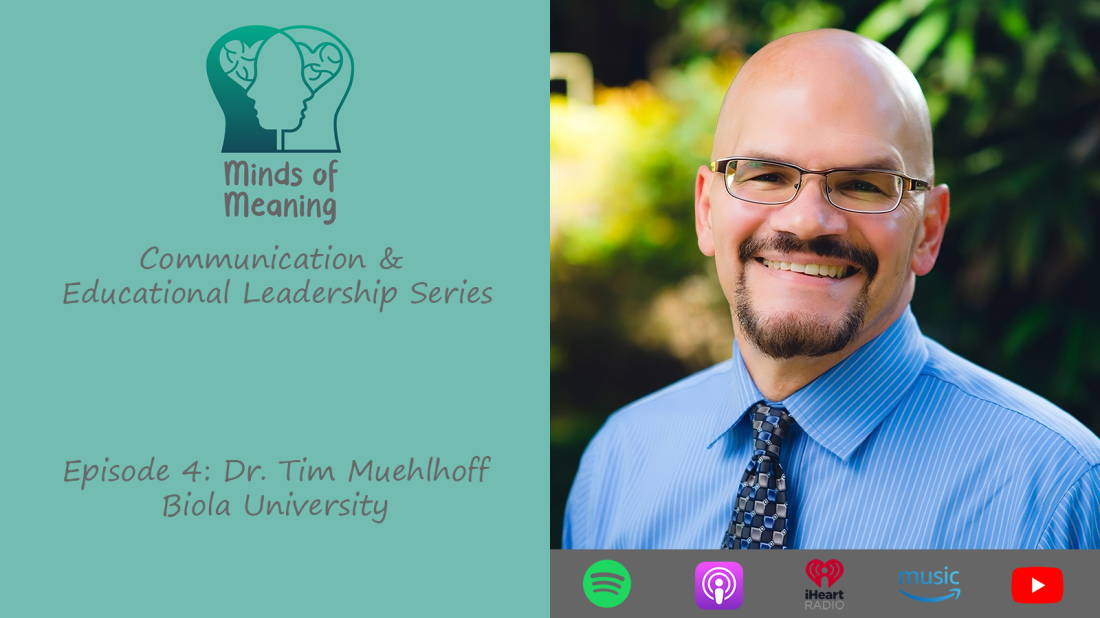
Communication & Educational Leadership Series Episode 4: Dr. Tim Muehlhoff

Dr. Tim Muehlhoff is a professor in the Department of Communication Studies at Biola University in La Mirada, California, where he has served for the past 20 years. We discussed the nature of the decline of liberal arts education, the importance of facial expression amidst leadership discussions, the current state of cancel culture, and many more topics as well.

Can We Solve Our Media Literacy Crisis?

Note: This article is written in response to the general public’s social media response to the assassination attempt of President Trump in Butler, PA, on Saturday, 7/13.

As a professor in digital communications, I look for the good in media to help influence the next generation.

As a general rule, most media outlets tonight did a terrific job across all political slants as each station provided solid commentary on how terrible the events were this evening and how we as a country need to band together and as Van Jones elegantly said tonight on CNN, “we need to look at our political opponents as opponents and not enemies.”

Rex Huppke absolutely nails this article on the head for USA Today, criticizing the general public’s outcries on social media channels, calling out conspiracy theories and other lies that were spread on social media as soon as the attempted assassination occurred.

The biggest issue we face in the current communication climate is not biased media, regardless of political views, rather the ability to spread misinformation freely at such a fast rate of time, and the ongoing increase of AI certainly accelerates the ability to provide information that may be untrue.

Media literacy is becoming more challenging daily. I don’t know what the answer is, but I can provide two suggestions:

1. Limit social media consumption. My only personal accounts are Facebook, LinkedIn, and Snapchat. I am no longer on Instagram, no X, or TikTok. The latter two can especially be catalysts for misinformation.

2. Provide education and guidance to the younger generations, who have grown up with media their whole lives. The way that media has been incorporated into their lives at such a young age means there is no understanding of life for that generation without it. I believe our goal as a society is to teach the younger generation that it is okay not to be fully consumed in media and provide further learning opportunities outside of digital technology when applicable. I am working on this, too, and I think we can be examples to the younger generation of how to effectively limit digital communication content intake.

I am blessed to teach the next generation of students how to be effective communicators, but it is going to take much more than just all of us communication instructors to help create positive change in media literacy.