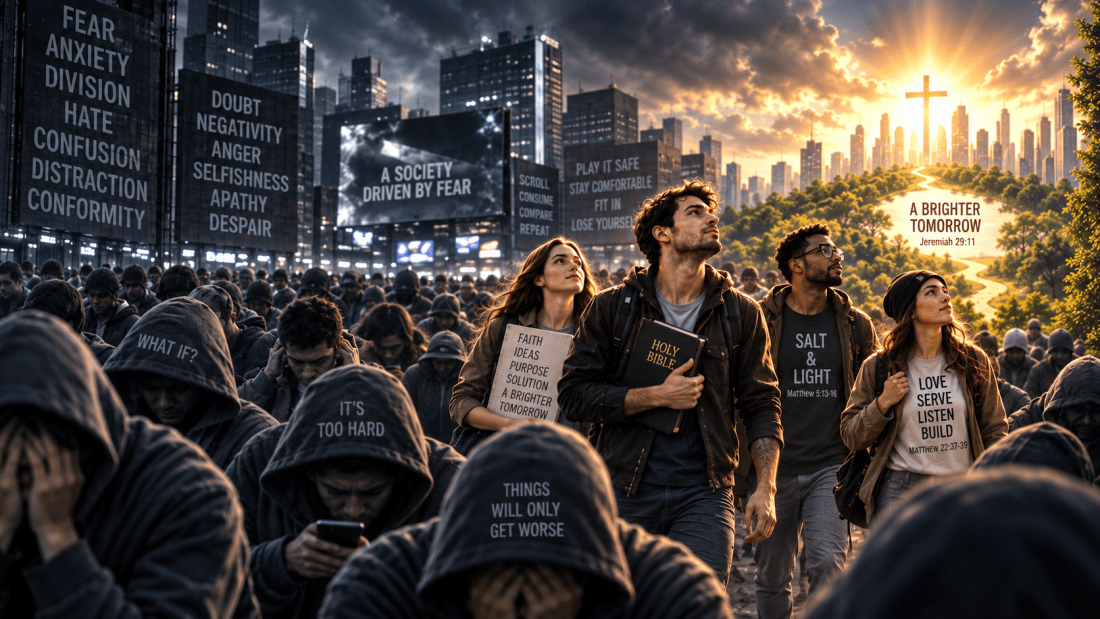
Image generated from a ChatGPT prompt.
Merriam-Webster defines a visionary as an individual who has “foresight and imagination.” I strongly believe that many people in our society have a visionary mindset. Silicon Valley Visionary John Rampton defines five specific characteristics of visionaries: persistent resilience, inspirational charisma, innovative creativity, adventurous audacity (risk-taking), and collaborative communication.
In recent discussions with another visionary friend, we discussed how often we have ideas and desires about specific plans for our blogs/podcasts, education, music, small businesses, and our vocational plans/platforms. These plans, albeit often holistic and God-honoring in nature, may not line up with the specifics of the unrevealed life plan that God has for us, often leaving many creatives to sit in a place of frustration and fear, trying to discern the right approach, while also humbly realizing that our fleshly understandings of our best motives cannot match the plans of the divine.
What’s worse, our information-based, risk-averse society has often led to social media narratives suggesting taking the safe routes of life, subliminally suggesting that the best course of living is to worry about the next steps of surviving adulthood in a society that is becoming more vastly different in thought expression, and the ideals of the “good life” are significantly different from person to person; oh, and society is becoming more expensive than ever, making some of these dreams more difficult to realize.
Some of the aforementioned issues are practical obstacles that visionaries must contend with daily, while others may be perceived worries or concerns that visionaries spend an unnecessarily significant amount of time processing. Episcopalian Minister and Philosopher Ian Morgan Cron, a visionary himself, notes that many individuals, amid the frustrations of not reaching peak productivity, often repeat the following statements to themselves.
“Anything that goes wrong is my fault.”
“I’ll always end up [feeling] alone.”
“I can’t be ok unless everyone else is okay.”
“People won’t love me unless I am a success.”
“No matter how I try—I never do anything right.”
All of these statements may be microscopically valid in certain situations, but the majority of the time, these answers are absolutely untrue. A route towards living a miserable life is to take these specific claims and project blame on oneself for not completely acing a self-administered test for living a subjective “perfect” life.
This sounds like a ridiculous narrative until we take a look at our own lives. If we think deeply enough, we may realize that all of these statements are the concepts that we continue to share with ourselves, which may inhibit us from doing the work God calls us to do. Now, I will say that the road to doing God’s will with our creative talents is often a game of tug-of-war, as we fight God’s plans with our own fears and worries, often leading us to rebel from God in the midst of our frustrations, leading to sin patterns in our lethargic doubts about yet another frustration in the timing of God’s plan for us. Thankfully, by God’s grace, he gets us back on our feet. The reality is that if we turn from our doubts and live our lives in submission to God’s call, prayerfully discerning how to use our creative gifts in a righteous manner, we will be led to a place of divine peace.
Maybe you will not become the famed public speaker you desired to be, or maybe the podcast you start may only have 15 loyal listeners in year three, but understand that pursuing passions that align with God’s will will be fulfilling at the end of the day. Specifically, in my life, I am making a significant effort to limit my weekly schedule so that I can be present in the day-to-day nuances of my workday. I have found that my teaching has improved, that I have more capacity to care for my students, and that I am a place of much greater peace.
To train my mind to be more attuned to assisting others, I am writing down a list of things I have helped others with outside my normal schedule. Although repeatedly writing this list may become prideful, I am praying that a one-week exercise can help God show me how I can best assist others with my creative talents in the season God has called me to in this moment. In other words, understanding where my feet are currently.
In the Old Testament, David desired to build a house to store the Ark of the Covenant, where God dwelt, in a place of cedar, but God said the ark should remain in a tent, saying that the Lord builds the house, not David. David later submitted to God’s plan and continued to live his life for the Kingdom.
Another Old Testament saint, Moses, continued to experience significant moments of tension with God. Although not every result goes his way, Moses, in the book of Exodus, as reminded by dailyradiobible, teaches that the most important lesson from his often tension-filled relationship with God is to “value presence over outcomes.” And that presence can continue to be experienced not by living a fear-based life, but by praying boldly and seeing the awe of God’s power.
Our society, by the nature of technology and immediacy, will continue to encourage a life of fear and self-doubt. Our fear-driven selves are often going to face psychological and spiritual warfare, trying to specifically discern what God’s plan is for the creative. However, as Cron notes, if we switch our mindset of how we view God with biblical evidence, then it can lead to a life-altering perspective change from one where God is a monarchical ruler with no interest in seeing the best of his followers, to a perspective where we see the Holy Trinity as the One full of grace, truth, and love, who desires us to communicate with him with bold requests, and will, in time, reveal the best outcomes for our lives as believers.

