
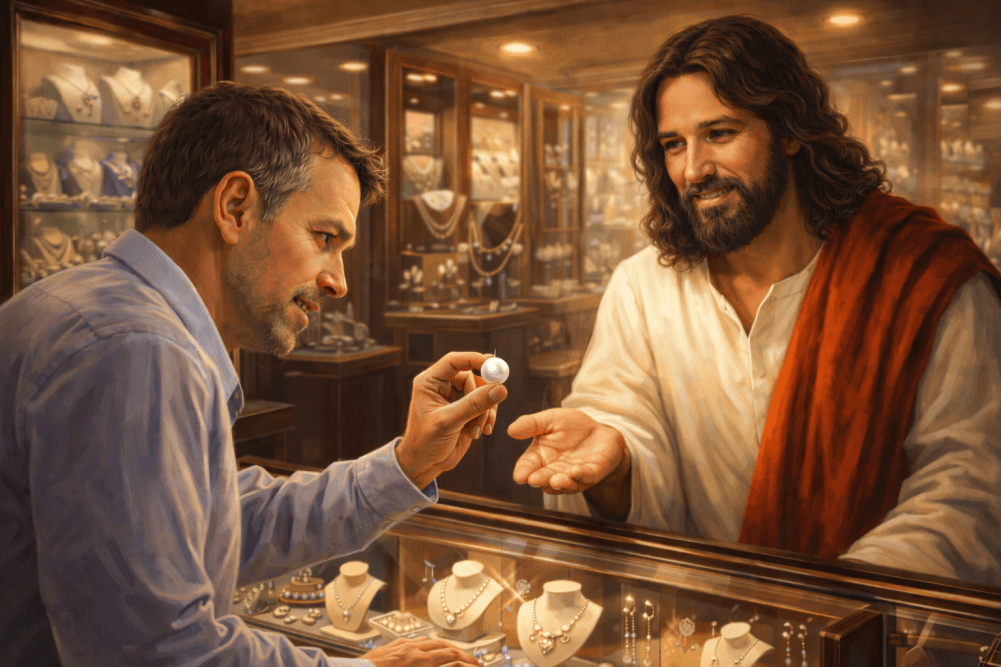
(Image generated by ChatGPT AI)
I often find it easy to compare myself to others in terms of salary, housing, relationship status, living situations, life goals, and many other aspects. Many lives I covet, many I don’t, but the reality is that when I simply put my mind in a mindset of conquering the obstacles of my own individual universe, there is always some element of that pursuit that is unfulfilling. From what I gather, others feel similarly.
Similar enough that I have heard several sermons that have dealt with some aspect of resetting our minds to live in the mindset Christ calls us to.
Pastor Brad Wetherell, senior pastor of the Orchard (Chicago), focused this week’s sermon on Matthew 16:21-28, discussing the cost of discipleship. Jesus modeled the cost of discipleship by giving up his own earthly life to save the souls of those who believe in the triune God. We, as Christians, must follow Jesus by surrendering our entire lives to him, to the point of denying ourselves the perceived rights we have and opening our hands to allow God to encounter us with His holy perspective.
Wetherell notes from verse 26 (“For what will it profit a man if he gains the whole world and forfeits his soul?” [ESV]) the idea that we should not be so focused on the path of this world to the point that we are anxious, flustered, and worried about how we are to continue in this world by being protective of what we “own.”
James 5 shares similar undertones to Matthew 16: earthly possessions will be worth nothing in the afterlife. Recently, at Solid Rock Church in Elgin, IL, Dr. Bill Doran cited the parable of the pearl (Matthew 13:45-46) in his sermon. Doran’s elaborated recitation of this story features a man saw a pearl in a jewelry shop and asked how much it cost, the jeweler replies that it will cost everything that he specifically owns. The man goes home and brings forth all of his possessions, and the jeweler gives the man the pearl. Additionally, the man returns all the possessions to the man but says he must steward the sold possessions as the jeweler deems necessary.
The jeweler certainly represents Jesus in this story, and it is a great illustration that we need the pearl of salvation to receive the greatest gift of all: our salvation. But in exchange, we must surrender ourselves to God’s mission in order to live like Christ.
This story may not be new to many readers, but I believe Christians often undersell how much we are to fully surrender to live the Christian walk. It is a daily call that we need to remind ourselves of.
One can apply to their call by providing attention in addition to intention. Rick Williams, Judson University’s director of athletics, lives by this mantra, meaning that we should not only intend to do what God calls us to do, but also be present and pay attention to the current moment. As it says in Matthew 6:34 (ESV), “[t]herefore do not be anxious about tomorrow, for tomorrow will be anxious for itself. Sufficient for the day is its own trouble.”
Discerning how to live Godly in the present moment will play a significant role in transforming our lives and enabling a holy mindset. As Wetherell said to conclude his sermon, “Remember that whatever it costs, you will gain infinitely more.”



 Minds of Meaning